NOTE: These settlement timelines are automatically managed by OneKhusa based on payment method, the merchant is not required to configure this.
Key Concepts
| Term | Description |
|---|---|
| Transaction Date (T) | The day a payment is successfully processed. |
| Settlement Date (T+n) | The day funds become available for payout. |
| Pending Balance | Funds captured but not yet settled. |
| Available Balance | Funds eligible for disbursement (payout) or auto-sweep. |
Settlement Cycle Matrix
Understanding the distinction between T+0, T+1, and T+2 settlement models helps developers understand settlement timing, which directly impacts liquidity, reconciliation, and user experience.| Model | Settlement Time | Description | Flow |
|---|---|---|---|
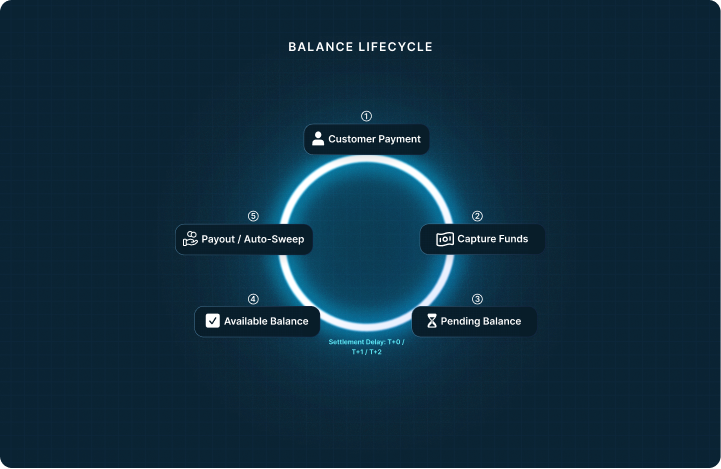
| T+0 | Same Day / Instant | Funds will settle and reflect in the merchant account within 10 minutes. This applies to local mobile money wallet and bank account payments only. | 1. Customer makes payment. 2. Transaction is authorized and captured. 3. Funds remain in Pending Balance for 10 minutes. 4. Funds are released to Available Balance. 5. Merchant can disburse funds or initiate auto-sweep instantly. |
| T+1 | Next Business Day | Funds will settle and reflect in the merchant account within 24 hours. This applies to local card payments and direct MNO push payments. | 1. Payment is processed on Day T. 2. Funds remain in Pending Balance. 3. Funds are released to Available Balance on T+1 for payouts. |
| T+2 | 2 Business Days | Funds will settle and reflect in the merchant account within 2 business days. This applies to international card payments and cross-border payments. | 1. Payment is captured on Day T. 2. Funds are held in Pending Balance for risk checks. 3. Funds are released to Available Balance on T+2 for payouts. |
IMPORTANT : In sandbox environment, T1 and T2 settlement periods are set to settle funds to merchant account within 10 minutes for successful payment transactions.
Balance Lifecycle